Kitchen Cabinet Painting Seattle: What Pacific Northwest Humidity Actually Does to Your Cabinets
Three years ago I walked into Jennifer Walsh's Ballard craftsman. She'd painted her 1940s fir cabinets herself during COVID lockdown — YouTube tutorials, premium-looking latex from Home Depot, two coats, looked great. By the time she called me, those cabinets were bubbling at every seam and peeling back from the frame edges in pale, papery strips. She was embarrassed. "I followed every step," she said. I examined the wood and I wasn't surprised. Fir grain — the dominant species in pre-1960s Seattle kitchens — rises when moisture penetrates between a finish coat and an unprepared surface. In Seattle, with 37 inches of rain per year and 152 days of measurable precipitation, that process happens faster than anywhere else in the Pacific Northwest. Her technique wasn't wrong. Her paint system wasn't built for where she lives.
That conversation changed how I talk to Seattle homeowners. This isn't Scottsdale. Cabinet painting in a city that cycles through seven months of damp, overcast weather requires different materials, different prep, different timing. I've done 200+ Seattle kitchens across Capitol Hill, Queen Anne, Ballard, Green Lake, Madison Park, and South Lake Union. The results — and the failures I've seen from others — taught me exactly what this climate demands.
Seattle avg. relative humidity: 72%
Highest of any major Pacific Northwest citySave $28,000–$45,000 vs full replacement
Professional painting: 5–7 days, kitchen stays functional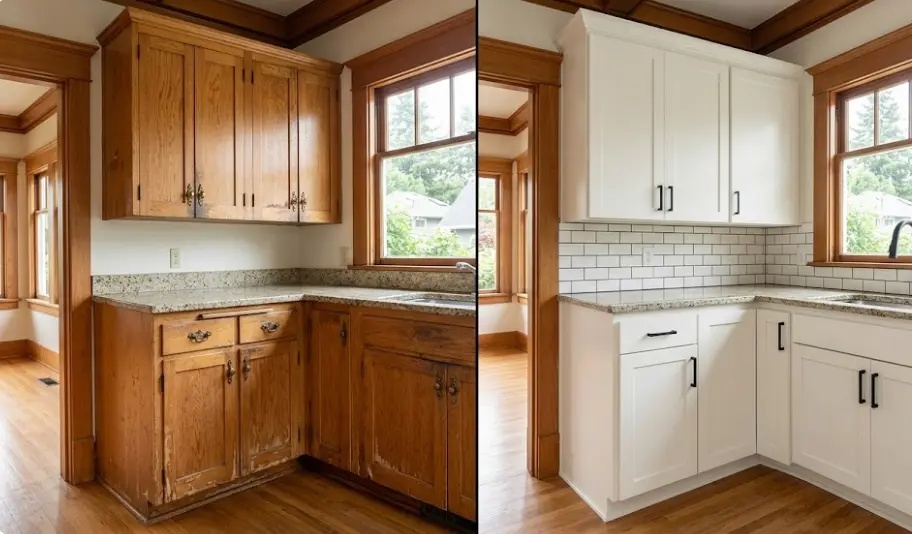
The Seattle Problem Nobody Talks About
Why cabinet paint jobs here fail faster — and how to stop it
Fir Grain Rise: The 1940s Seattle Kitchen Trap
Roughly 60% of the single-family homes I work on in Seattle were built between 1910 and 1960. The cabinets in those houses — when original or period-replaced — are almost always Douglas fir or alder, species with open grain structures that respond dramatically to humidity changes.
When the grain rises under a freshly painted surface, it creates micro-ridges you can see and feel. In dry climates, this is a manageable cosmetic issue. In Seattle, where humidity swings between 60% and 90% through the rainy season, it creates separation between wood and coating that lets moisture in. From there, peeling is inevitable.
The fix isn't a better topcoat. It's grain-filling before primer — a step that adds time and materials but eliminates the problem entirely. I've been doing it on every fir-cabinet job for four years. Jennifer Walsh's Ballard kitchen, redone properly, has had zero issues for 26 months through two Seattle winters.
The Condo VOC Problem
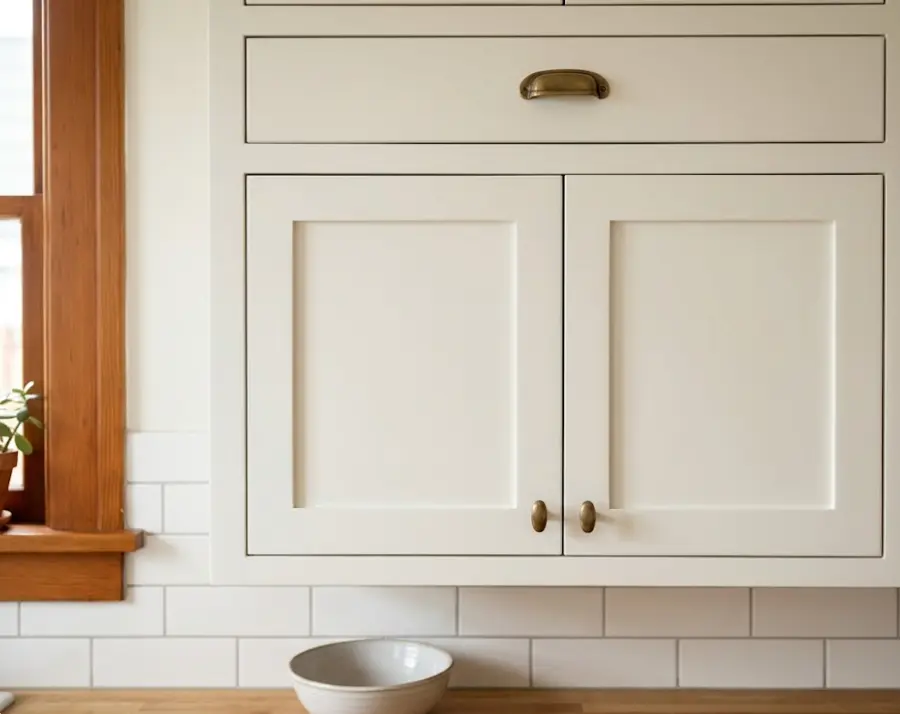
Seattle's condo market — South Lake Union, Capitol Hill, Belltown, First Hill — runs on tight floor plans and shared ventilation systems. Most buildings built since 2000 have mechanically ventilated kitchens where cooking odors, humidity, and airborne grease particles circulate continuously.
That environment degrades standard cabinet paint faster than almost any residential setting. The finish around handles gets greasy-soft within months. The finish near the range hood loses adhesion. I've seen factory-installed cabinet finishes in 10-year-old condos look worse than hand-painted cabinets done properly with the right topcoat.
For condo kitchens I use a two-component conversion varnish system — essentially the same material used on commercial restaurant furniture. It's harder than standard latex, completely non-porous, and unaffected by the grease particles that shorten the life of every other paint I know of.
Why "Works Great in Bellevue" Isn't Enough
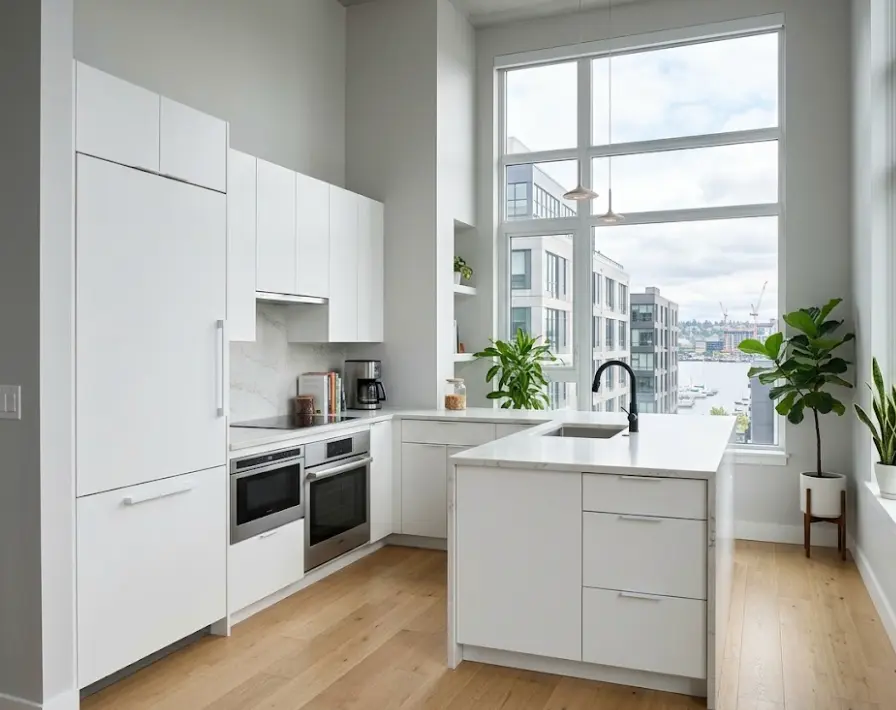
I get calls from homeowners who hired painters whose portfolio was entirely Eastside suburban — Bellevue ranch houses, Sammamish new construction, Redmond tech homes. Those are good-quality projects. But the material choices and prep protocols that work flawlessly in those environments are genuinely insufficient for a Queen Anne Victorian or a Capitol Hill converted apartment.
The elevation matters. The age of the structure matters. Whether the kitchen faces north (stays cool and damp) or south (heats up enough to accelerate off-gassing from old finishes) matters. I track these things because they've bit me before. A Magnolia home where the kitchen backed up to an uninsulated northwest-facing exterior wall — that cabinet box was cycling between 38°F and 68°F from November through February. Standard primer adhesion wasn't going to hold. I used shellac-based primer there, the same system used for knot-blocking in timber framing, and it hasn't moved in three years.
Seattle Neighborhood by Neighborhood
What I've learned from 200+ Seattle kitchens
Craftsman Country: The Fir Grain Capital
Ballard and Fremont have the highest concentration of original-condition craftsman kitchens I work on anywhere in Seattle. Many homeowners here have original fir cabinets with painted or stained surfaces that are 70–90 years old — and they want to keep them. That's the right call. Pre-war fir is structurally superior to any modern MDF cabinet. The challenge is giving it a contemporary look without triggering the moisture-adhesion issues common in this wood.
For these jobs I spend two days on prep alone. Grain filler, shellac primer, then a waterborne alkyd topcoat applied at controlled humidity — not on rainy days, not when the afternoon fog rolls in off Puget Sound. The Clark family on 65th Ave had 1937 fir cabinets that their realtor called "unsalvageable." They're now the centerpiece of a kitchen that sold their house $54,000 above asking.
The Tech Renter Turnover Problem
Capitol Hill is where Seattle's tech workforce lives in density. The kitchens here are mostly late-2000s through 2010s condos with builder-grade maple or oak cabinets — fine structural quality, boring appearance, worn finish from heavy use. These homeowners often bought during the Amazon hiring surge and are now either preparing to sell or finally settling in after years of "we'll fix it later."
What I see consistently: the finish around drawer pulls and door handles has worn through to raw wood. The inside corners near the sink show early delamination. These aren't failures of the original cabinetry — they're wear patterns that happen to every kitchen used by people who actually cook. Professional painting addresses all of them, resurfaces the entire piece uniformly, and adds 10–15 years to the cabinet life.
Marcus and Devon Kim on 12th Ave — Amazon PMs who'd been staring at their dated honey-oak kitchen for four years — had me transform it in six days to a clean off-white with matte black hardware. Their building's HOA president asked them if they'd done a full gut renovation.
Victorians, Views, and Insulation Gaps
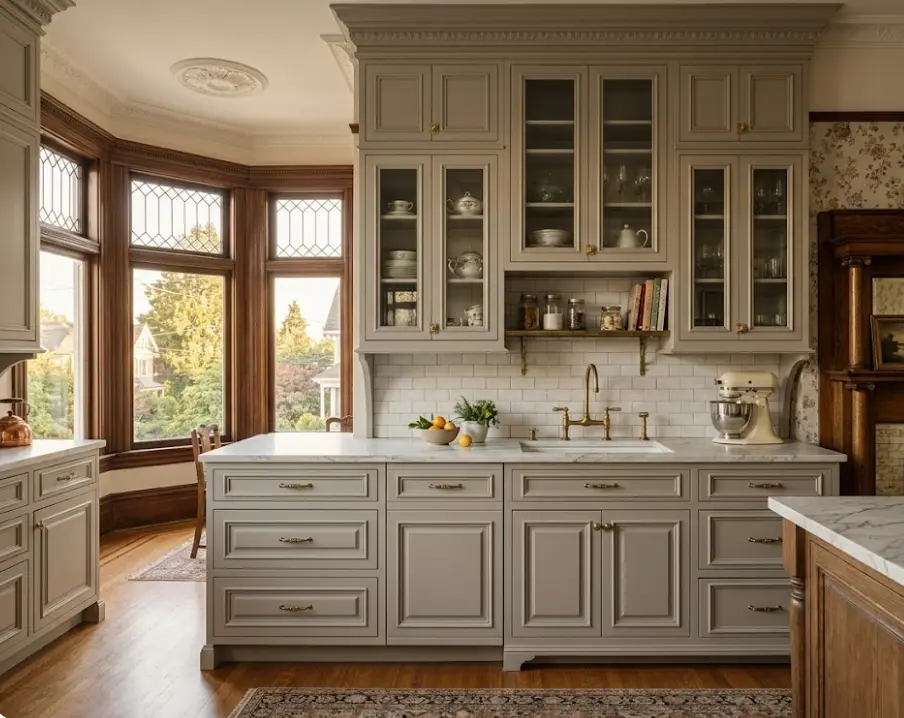
Upper Queen Anne and Magnolia are where the money lives in old Seattle money. These are 1920s–1940s Victorians and colonials with kitchens that have been renovated once or twice over the decades — sometimes well, sometimes badly. I regularly find painted cabinets with three or four previous layers of incompatible products, which creates its own prep challenge.
The view-facing kitchens on the west side of Queen Anne are also the most climate-stressed. West-facing windows bring in afternoon glare in summer and driving rain in winter. Temperature swings between daytime sun and nighttime Pacific air can be 30 degrees in a single day. Every joint in a cabinet box expands and contracts with that swing. You need a topcoat with enough elasticity to move with the wood — standard hard-curing products crack.
Patricia Brennan on West McGraw — retired Boeing engineer who had restored most of her own 1929 house — came to me because she'd stripped and repainted her cabinets twice and kept getting cracking at the joint lines. I identified the root cause in about ten minutes: she'd been using an architectural latex that cures too rigid. Switched her to a semi-flexible alkyd system and the problem disappeared.
Waterfront Premium and Resale Intelligence
Madison Park and Laurelhurst are Seattle's lakefront neighborhoods, and their kitchens behave more like Kirkland waterfront than like the rest of Seattle. Lake Washington creates a microclimate — higher overnight humidity, morning condensation on cool surfaces, and consistent moisture exposure for kitchens on the lake-facing side of homes.
The buyers in these neighborhoods are also the most discerning. When David Park, a portfolio manager in Madison Park, told me his realtor had said the kitchen was holding the home's value back, I knew exactly what she meant. Buyers at $1.8M+ are walking through homes with a trained eye. They notice inconsistent sheen, they notice brush marks on drawer fronts, they notice when a white cabinet is slightly warm versus slightly cool in a way that clashes with the countertop. I've developed a color consultation process specifically for this market tier because the stakes of a wrong color choice are measured in tens of thousands of dollars.
David's kitchen went from dated almond-white to a sophisticated greige that his realtor called "perfectly positioned for the current buyer profile." Final sale: $72,000 above list. Investment: $6,400.
Family Kitchens That Actually Get Used
Green Lake and Wallingford are where Seattle families live — good public schools, 1950s ranches and 1960s split-levels, kitchens that see three meals a day and after-school chaos. These aren't staging projects. They're working kitchens that need a finish that survives kids, dogs, homework sessions at the island, and serious cooking.
The Thompson family on Stone Way had four kids under twelve and a golden retriever. Their 1998 oak cabinets were functional but scratched, discolored around the handles, and had one drawer front that a previous repair had left slightly mismatched. I refinished everything in a warm sage green — a color that reads as calm and contemporary but hides fingerprints better than any neutral I know. The textured topcoat I used adds micro-grip that makes the surface feel intentional rather than worn. Two years later, it still looks like the week I finished it.
Amazon Campus Living: New Build, Old Problems
The apartments and condos around South Lake Union look new because most of them are — 2012 through 2022 construction, modern appliances, builder-grade finishes that were acceptable new but are showing their age after 10 years of heavy use by tech workers who order DoorDash six nights a week and then suddenly start cooking.
The issue here is different from craftsman Seattle: it's not wood movement, it's surface contamination. Builder-grade pre-finished cabinets have a factory UV-cured finish that's hard, smooth, and absolutely hostile to adhesion. Standard primer slides off it. I use a specialized bonding primer specifically formulated for non-porous factory finishes, then scuff-sand between every coat with 320-grit. Without that protocol, the paint won't last six months. With it, I've had South Lake Union clients reach out at the 4-year mark just to tell me nothing has happened.
Four Seattle Kitchens, Four Different Stories
Real projects, specific results
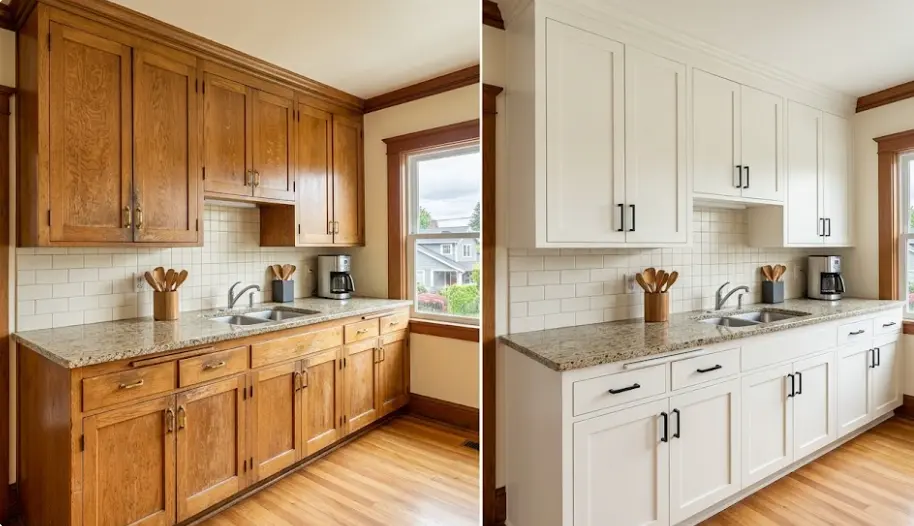
The 1937 Ballard Fir Problem
Location: Ballard • Investment: $4,800
The Clark family's 87-year-old fir cabinets had been written off by two contractors and their own realtor. "Replace them," was the unanimous advice. I spent an afternoon examining the cabinet boxes — original tongue-and-groove construction, solid as brick, beautiful proportions. The only problem was the degraded factory stain and the grain texture that previous DIY attempts had made worse.
Two days of grain filling, shellac primer, three coats of Benjamin Moore Advance in a soft warm white. The kitchen went from being the listing's weakness to its centerpiece. Home sold for $54,000 above the agent's pre-renovation estimate. The buyer's inspector commented that the cabinets were "better quality than anything built today."
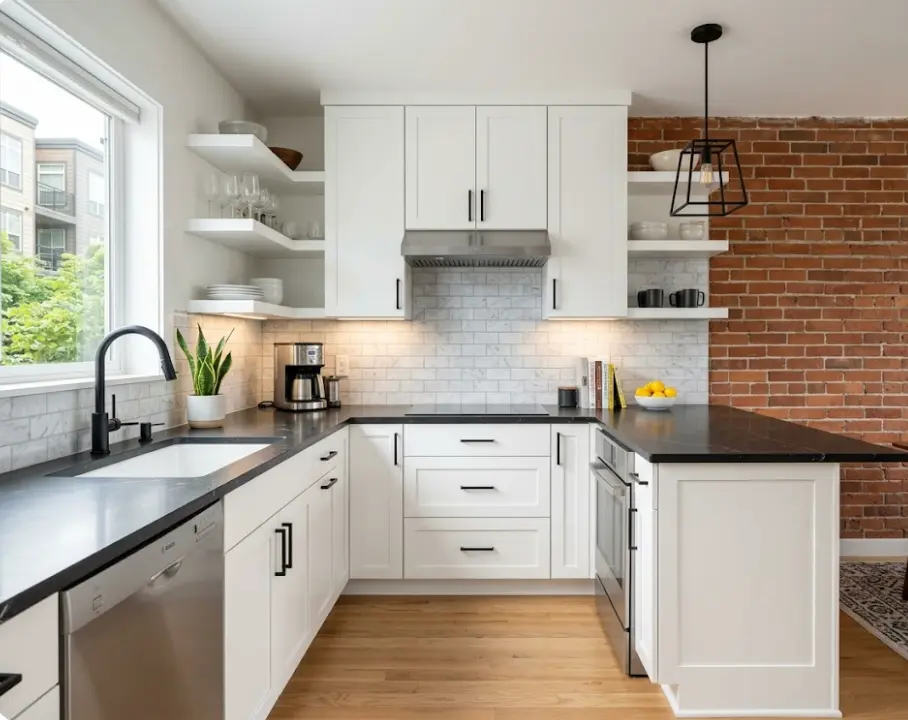
Capitol Hill: Four Years of Waiting, Six Days of Work
Location: Capitol Hill • Investment: $3,900
Marcus Kim had been living with honey-oak cabinets in his 2008 condo since the day he bought it. "I kept thinking I'd gut the kitchen eventually." When Amazon announced return-to-office and he decided to sell instead of relocate, the kitchen suddenly became urgent. Two-bedroom condos on Capitol Hill were sitting longer in 2024 unless they showed well.
Six days, factory-grade bonding primer, three coats of Sherwin-Williams ProClassic in Alabaster. Matte black hardware that Marcus picked himself. The listing photos looked like a different apartment. His agent had three showings the first day and an accepted offer in 11 days — $41,000 above the initial list recommendation.
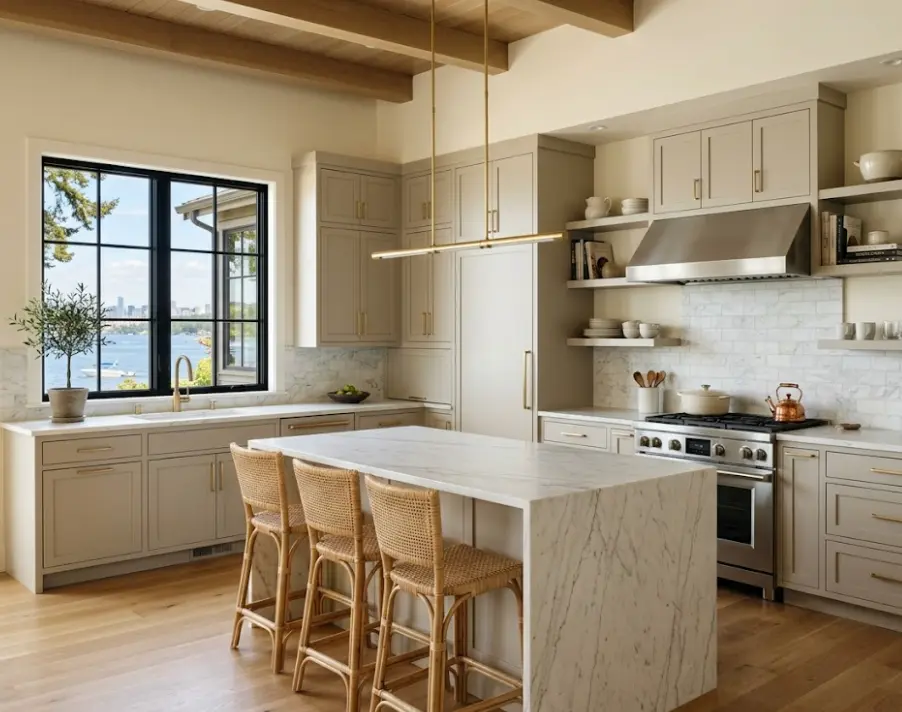
Madison Park: When Color Is a $70K Decision
Location: Madison Park • Investment: $6,400
David Park's realtor had given him a range: the kitchen, as-is with dated almond cabinets, cost him $80,000–$100,000 in market positioning. We spent three hours on color consultation before I touched a brush — comparing six greige options against his countertop, his tile, and current photos of comparable listings that had sold well.
The chosen color — Benjamin Moore Pale Oak — was specifically selected because it read as warm against his cool-gray countertops and as neutral in listing photos taken under artificial light. The waterfront humidity meant I used a moisture-resistant primer system on all exterior-wall cabinet boxes. Home sold for $72,000 above the revised estimate.
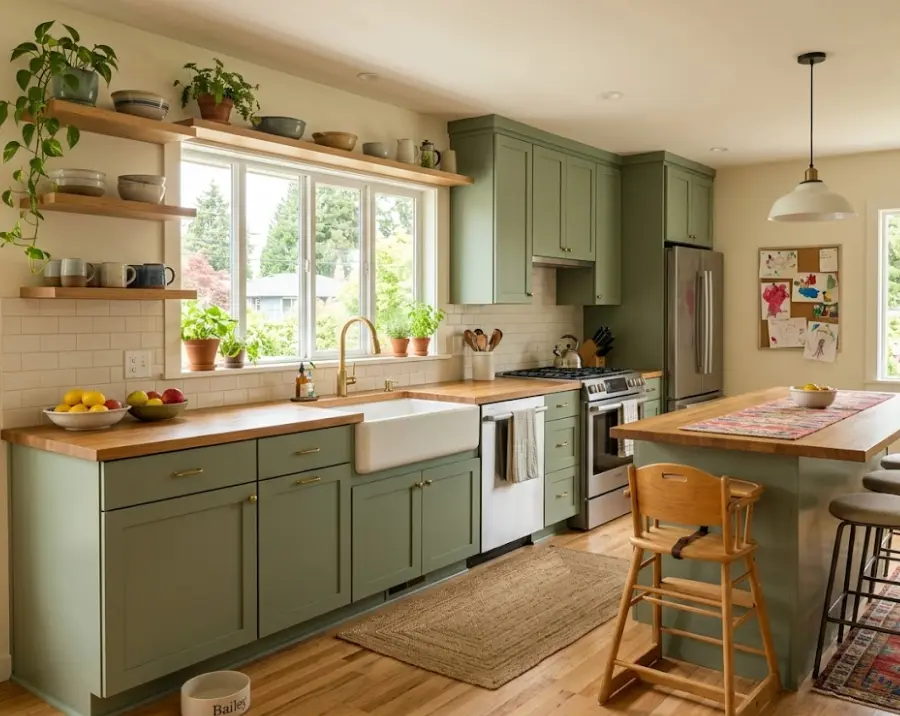
Green Lake: Four Kids and Still Perfect
Location: Green Lake • Investment: $5,100
The Thompson family wasn't planning to sell. They just wanted a kitchen they weren't embarrassed by. With four kids, two adults who actually cook, and a dog, the requirement wasn't beauty — it was durability. They'd ruled out replacement because tearing out a functional kitchen while homeschooling three of the four children was genuinely impossible.
I used a semi-gloss conversion varnish on all door and drawer fronts — the same product category used in commercial food-service environments. The sage green holds up to daily cleaning with whatever cleaning products they have on hand. Two years after completion, I got a text from Amy Thompson with a photo. "Can you believe this is from 2022? Still looks like you just left."
The Materials That Survive Seattle
Not all paint systems are built for Pacific Northwest conditions
Benjamin Moore Advance (Waterborne Alkyd)
My primary topcoat for wood-framed Seattle kitchens. Advance is a waterborne alkyd — it applies and cleans up like latex but cures to a hard, alkyd-like film that handles moisture cycling without softening. The extended open time lets it level flat even in the lower temperatures of a Seattle fall application.
Not available at Home Depot. Professional-grade product that costs roughly three times the consumer equivalent and outlasts it by a decade in humid climates.
Sherwin-Williams ProClassic (Alkyd Hybrid)
For factory-finished cabinets in condos and newer homes, ProClassic alkyd hybrid gives exceptional adhesion over non-porous surfaces that Benjamin Moore Advance occasionally struggles with. The cured film is harder than Advance and better suited for high-traffic drawer fronts in busy kitchens.
I choose between these two products based on substrate — the fir and alder of older Seattle homes responds better to Advance; the factory-finished maple and oak of newer buildings responds better to ProClassic.
Two-Component Conversion Varnish
For commercial kitchens, restaurant-adjacent work, and clients who genuinely need industrial durability — the Green Lake family with four kids, the South Lake Union household where someone cooks six days a week — I use a two-component conversion varnish. This cures to a film harder than any single-component product and is completely impervious to grease, cleaning chemicals, and repeated moisture exposure.
It requires professional spray equipment, proper ventilation, and more preparation time. It's also roughly 40% more expensive than standard professional paint. For the right client, the extra cost is irrelevant compared to the 20+ year service life.
Shellac-Based Primer: The Seattle Secret Weapon
Shellac-based primers are rarely used in residential painting because they're more expensive, require solvent cleanup, and are overkill in most environments. In Seattle, they're often the right call. Shellac creates an impermeable barrier between old wood, old finish residue, and new paint — which is exactly what you need on a 1950s kitchen cabinet that's absorbed 70 years of cooking odors and environmental moisture.
On problem surfaces — tannin-bleeding alder, resin-spotted fir, cabinets adjacent to uninsulated exterior walls — shellac primer prevents the staining and adhesion failure that leads to repeat paint jobs within a few years.
Grain Filler: The Step Most Painters Skip
Oil-based grain filler fills the open pores of fir, oak, and alder before primer is applied. It eliminates the surface texture that causes problems under paint in humid climates. It adds a full day to the project timeline and about $200 to material costs. It's the single most important step I do differently from general painting contractors on older Seattle kitchens.
You can see whether a painter used it by running your finger across a painted fir door face. If you feel the grain through the paint, it wasn't filled. That door will have problems within 3–5 years in Seattle's climate. If it's smooth, the filler was applied correctly and the finish will last.
How a Seattle Cabinet Job Actually Works
From first call to finished kitchen
Assessment: I Look at Your Specific Cabinets
Not color samples, not design concepts — the actual wood species, the existing finish condition, the substrate. Is this fir or alder? Factory-finished or previously painted? Any moisture damage at the sink base or dishwasher side? What's the temperature differential between the exterior wall and the kitchen interior in winter?
These questions determine material choices before I write a word of a proposal. A homeowner in Ballard with original fir cabinets and a north-facing kitchen needs a completely different protocol than someone in a 2015 Capitol Hill condo with factory-finished maple.
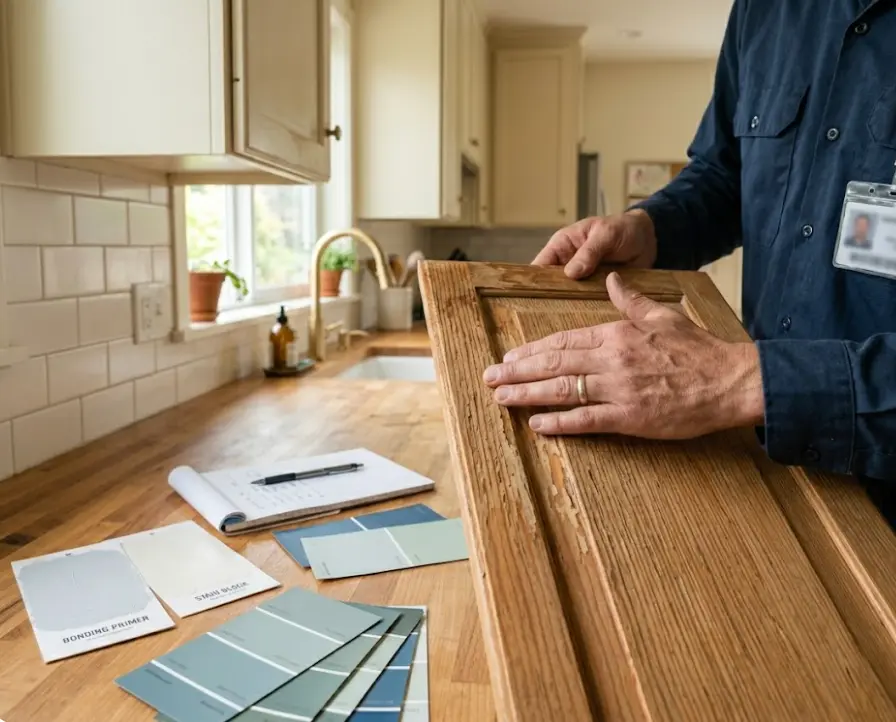
If I find particle board delamination, structural damage, or box failure during assessment, I'll tell you that replacement makes more sense. I turned down three jobs last year because painting wasn't the right answer. Those homeowners appreciated it.
Timing the Application Window
Paint curing requires specific conditions — temperature above 50°F, relative humidity below 85%, and stable enough conditions for three to four days. In Seattle from October through April, I don't start cabinet jobs without checking the extended forecast. I've declined to begin projects on weeks where the humidity will spike above 90% on day three.
That level of scheduling care inconveniences clients occasionally. It's also why my work in Seattle holds up when other painters' doesn't. Moisture trapped under an inadequately cured topcoat creates bubbling that appears months later, often attributed to "the wood moving" — but actually caused by the paint film never fully hardening.
The Preparation Work
Sixty percent of project time is preparation. Every door and drawer front is removed, labeled by position, and transported to my climate-controlled workshop. Cabinet boxes are degreased with TSP-PF, which removes the invisible film of cooking oils that prevents proper adhesion. On fir or open-grain wood, grain filler is applied and allowed to cure before sanding.
In the workshop, surfaces are sanded progressively — 120-grit to open the grain, 180-grit to smooth it, 220-grit to refine before primer. Each door is primed individually and allowed to cure before any topcoat. On older homes I may apply two primer coats, especially on cabinets adjacent to exterior walls.
Application and Curing
Three to four topcoat applications via HVLP spray system. Between each coat, 320-grit scuff sanding — not to remove material, but to eliminate any surface contaminants that landed during the previous coat's flash-off. Curing under controlled temperature. Final coat allowed a full 24 hours before I test adhesion with tape.
Cabinet boxes are sprayed in-place with professional masking protecting countertops, appliances, and flooring. Frames receive the same number of coats as doors.
Installation and Walkaround
Doors return fully cured — not "dry to the touch" but actually hardened. Reinstallation includes checking every hinge for proper alignment and adjusting where needed. The final walkthrough isn't a formality. I inspect every door and drawer under direct light at a raking angle that reveals any imperfection a standard overhead light hides. If I find anything that doesn't meet my standard, it gets corrected before I leave.
I also give a specific care rundown based on the topcoat I used — what cleaning products are safe, what to avoid for the first 30 days while the coating reaches full hardness, and how to address minor scuffs if they appear.
What Cabinet Painting Costs in Seattle
Transparent pricing for the work involved
Studio & Small Kitchen
- ✓ 10–14 doors/drawers
- ✓ Professional degreasing and prep
- ✓ Workshop spray finishing
- ✓ Premium waterborne alkyd topcoat
- ✓ Precise reinstallation
- ✓ Hardware adjustment
- ✓ 5-year finish warranty
Standard Seattle Kitchen
- ✓ 18–26 doors/drawers
- ✓ Grain filling for open-grain wood
- ✓ Color consultation included
- ✓ Multi-coat spray system
- ✓ Substrate-matched primer selection
- ✓ Interior cabinet painting option
- ✓ Hardware upgrade coordination
- ✓ Extended warranty
Luxury & Waterfront
- ✓ 28+ doors/drawers
- ✓ Two-component conversion varnish option
- ✓ Moisture-resistant primer system
- ✓ Two-tone color design
- ✓ Decorative glaze applications
- ✓ Interior cabinet finishing
- ✓ Hardware selection & installation
- ✓ Comprehensive warranty
Seattle Cabinet Replacement vs Painting: The Numbers
Full cabinet replacement in Seattle's market runs $28,000–$55,000 for a standard kitchen, plus 6–12 weeks of kitchen disruption. Professional painting costs $3,600–$8,500, takes 5–8 days, and delivers 80% of the visual impact while preserving cabinet construction that's often superior to modern alternatives. Documented Seattle client results: $41,000–$72,000 in home value increase on investments of $3,900–$6,400.
Every project starts with an honest assessment. If replacement makes more financial sense for your situation, I'll say so.
What Seattle Homeowners Say
After two Seattle winters and counting
"Two previous painters told me my 1940s fir cabinets were unpaintable. Antonio explained exactly why they'd failed before and what the correct process was. The grain-filling step alone was something I'd never heard of. Three Seattle winters later, the finish looks exactly as it did when he left. He understood my specific situation — old wood, north-facing kitchen — in a way that the others simply didn't."
— Jennifer Walsh
Ballard • 1940s craftsman, fir cabinets • $4,800"I'm a product manager — I ask a lot of questions before I hire anyone. Antonio answered every one of them: specific material specs, humidity thresholds for application, cure times, what happens if moisture gets under the coating. He knew the science. Six days later I had a kitchen that looked like a completely different apartment, and the listing sold in 11 days at $41K over asking."
— Marcus Kim
Capitol Hill • 2008 condo, factory-finished maple • $3,900"The color consultation was worth the entire project cost. I'd been staring at paint chips for two years and couldn't make a decision. Antonio came in, looked at my countertops, asked me three questions about how I photograph the space, and recommended Pale Oak. When the listing photos came back, my realtor said the kitchen was the strongest room in the house. We got $72K above asking."
— David Park
Madison Park • Waterfront home, 27 doors • $6,400"I sent him a photo recently — two years after the job — because I still can't believe how it looks. Four kids, a dog, constant use. The finish on the drawer fronts near the handles hasn't budged. He mentioned during the project that he was using a commercial-grade varnish because of how hard our kitchen gets used. I didn't fully understand what that meant at the time. I do now."
— Amy Thompson
Green Lake • 1959 ranch, family kitchen • $5,100"As a structural engineer I was skeptical anyone could make my Queen Anne Victorian cabinets look right without replacing them. The joint cracking I'd experienced twice before had made me pessimistic. Antonio identified the cause immediately — the topcoat I'd been using cured too rigid for the seasonal movement in that house. His solution was technically correct and the results are excellent. No cracking in 18 months."
— Patricia Brennan
Queen Anne • 1929 Victorian • $5,600"I refer Antonio to every client I work with whose kitchen needs updating before a sale. He's the only cabinet painter in Seattle I trust to understand the local conditions and actually select the right materials for each job. His Madison Park work helped close a listing that had been sitting for six weeks. The kitchen transformation was the specific thing the final buyers mentioned in their offer."
— Christine Holloway, Windermere Real Estate
Seattle area • Multiple referralsWhat I Stand Behind
Specific guarantees, not generic promises
5-Year Finish Warranty
Any peeling, chipping, or adhesion failure in the first five years is my problem, not yours. Professional repair or refinish at no cost.
Timeline Guarantee
Project completes on the agreed schedule or you receive a $200 credit for each day of delay. Professional management, no surprises.
Honest Assessment
If replacement makes more financial sense than painting for your specific cabinets, I'll tell you. I've turned down work when it was the right thing to do.
Licensed & Insured
Fully licensed Washington State contractor, bonded and insured. Written contract on every job. No cash-only, no verbal agreements.
More Seattle and Eastside Painting Services
Complete painting solutions throughout King County
Interior Painting
Professional interior painting in Seattle to complete your transformation.
Exterior Painting
Expert exterior painting Seattle using Pacific Northwest weather-rated coatings.
Drywall & Patching
Complete surface prep with wall painting service in Seattle.
Ready to Talk About Your Seattle Kitchen?
The first conversation is an assessment, not a sales pitch. I'll look at your cabinets, identify the specific challenges of your kitchen and neighborhood, and give you an honest answer about whether painting makes sense. If it does, I'll explain exactly what the right approach looks like for your situation — not a generic estimate, but a specific plan for your wood species, your climate exposure, and your goals.
Serving All Seattle Neighborhoods Capitol Hill, Ballard, Queen Anne, Madison Park, Green Lake, Magnolia + more
Built for Pacific Northwest Conditions Materials and protocols specific to Seattle's climate
Or call directly:
