Professional Painters Everett: What 130 Years of Housing Stock Teaches You About Paint

Maria Delgado called in late spring about her grandmother's house on Grand Ave in the Riverside neighborhood — a 1907 Craftsman that had passed through three generations of the family and been painted, by her estimate, at least eight times since the war. The trim was so thick with paint that the original fir molding profiles had nearly disappeared. She wanted a fresh exterior and asked what it would cost. I told her I needed to see it first.

What I found was eleven distinct paint layers, confirmed by a test cut in an inconspicuous corner. The bottom two layers tested positive for lead. This wasn't a painting job — it was a lead-safe remediation project followed by a painting job. Full RRP containment, HEPA vacuum, proper disposal. Then heat gun and chemical stripper to get back to bare fir on the trim, where the profile had been buried under two inches of buildup. Three days of prep before a single coat of primer went on. Maria hadn't budgeted for any of this. But she understood, after I explained it, why every previous contractor who'd just rolled another coat over the top had created the situation she was now dealing with. The house looked the way it should have looked for the past forty years when we finished.

Everett has some of the oldest housing stock in Washington State

Riverside and Rucker Hill homes from 1892–1915 — lead paint near-universal below 1940s layers

Three-sided saltwater exposure accelerates paint failure

Puget Sound + Port Gardner Bay + Snohomish River — salt air reaches 3 miles inland
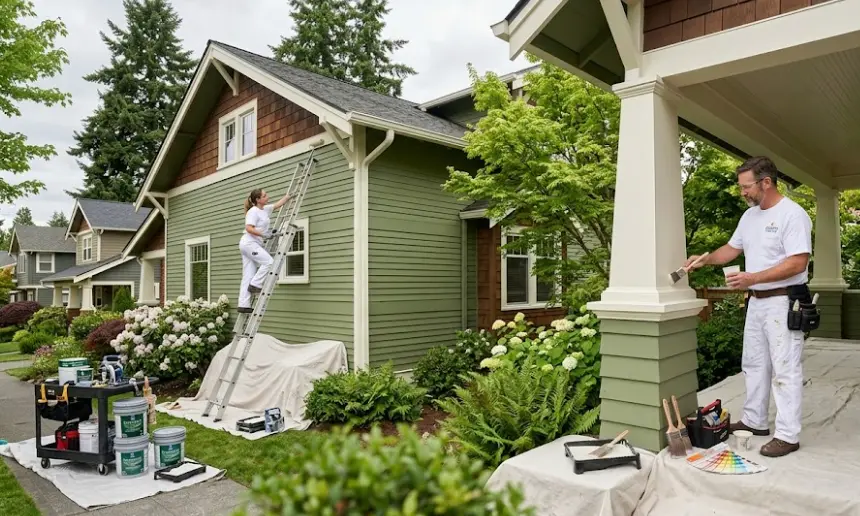
Professional painters working on a historic craftsman home in Everett WA with proper prep and lead-safe practices

Why Everett Is Not a Generic Painting Market

The specifics that any professional painter in this city needs to know

The Lead Paint Reality in Everett's Oldest Neighborhoods

Everett was founded in 1891 and experienced rapid growth through the Rockefeller Boom and subsequent decades of timber and fishing industry expansion. The Riverside neighborhood dates to 1892. Rucker Hill was developed in the 1890s through the 1910s. The NW neighborhood filled in through the 1920s. This is the oldest urban housing concentration in Snohomish County, and nearly every home that predates 1940 has lead-based paint in its original layers.

EPA RRP (Renovation, Repair and Painting) certification is legally required for any contractor disturbing more than six square feet of painted surface in a pre-1978 home. I'm RRP certified. In Everett's historic neighborhoods, this isn't a technicality — it's a genuine health consideration. Lead dust from improperly managed paint disturbance is a real risk, particularly for families with young children. I've been asked by homeowners whether their contractor was RRP certified, and more often than not the answer, when they checked, was no.

Before I give a quote on any pre-1940 Everett home, I use a lead test swab on the areas to be disturbed. It takes five minutes and determines whether RRP protocols apply. I'd rather know before the project starts than discover mid-scrape that I need to reconfigure the job.

RRP certified lead-safe paint removal on a 1907 Craftsman in Everett's Riverside neighborhood with proper HEPA containment

Salt Air From Three Directions

Most Eastside painters work in cities where the nearest saltwater is fifteen miles away and upwind effects are minimal. Everett is genuinely different. The city sits at the confluence of Puget Sound, Port Gardner Bay, and the Snohomish River delta. Prevailing southwest winds carry salt aerosol off the water and deposit it on west and south-facing surfaces throughout the city. Research from marine coating applications suggests salt air penetration is meaningful up to three miles inland in direct-line coastal exposures — and much of Everett's older housing stock sits within that zone.

Salt air does two things to exterior paint: it accelerates chalking by breaking down the binder in acrylic latex topcoats, and it attacks adhesion at substrate interfaces, particularly at bare wood and at failed caulk joints. Homes on the western slopes of Rucker Hill and in the Bayside and Port Gardner neighborhoods see this effect most acutely — their west-facing elevations require repainting two to three years earlier than east-facing sides of the same house, and they need a more film-build-focused exterior product than you'd specify for an inland Snohomish County home.

I use Sherwin-Williams Resilience or Duration on Everett exteriors specifically for their higher film build and stronger mildew resistance — both properties that matter more here than they do in, say, Woodinville or Sammamish.

Exterior paint prep on Everett WA home near Puget Sound showing salt air chalking on west elevation and proper surface preparation

Boeing and the Industrial Particulate Factor

Everett is home to Boeing's largest commercial aircraft assembly facility. Industrial activity of this scale deposits microscopic particulates — fine aluminum oxide, composite fiber dust, general industrial fallout — across a wide area downwind. This affects painting in a practical way: north and east-facing surfaces accumulate a layer of fine grit that doesn't come off with standard pressure washing alone. It embeds in the surface chalk and creates a barrier between the old paint and new primer that compromises adhesion.

I've pressure-washed Everett homes at 1,800 PSI and still found a gray residue on the north elevations that didn't move. Those surfaces get a TSP (trisodium phosphate) wash by hand, rinsed thoroughly, before primer. It adds an hour to the prep day but it's the difference between new primer bonded to the substrate and new primer bonded to a layer of industrial dust that'll eventually separate.

This is specific to Everett in a way that doesn't apply to most Snohomish County markets. Painters who work primarily in Bothell or Edmonds and occasionally pick up Everett work typically don't account for it. I do, because I've seen what happens when you don't.

Mid-century Boeing worker ranch home in South Everett WA being professionally painted with proper industrial particulate prep

Everett Neighborhoods: A Painter's View

What I actually find when I walk properties in each part of the city

Rucker Hill

Everett's Victorian Showcase

Rucker Hill is one of the founding neighborhoods of Everett, developed by the Rucker family who were among the original Rockefeller-era investors in the city. The homes here are genuine late-Victorian and early Edwardian architecture — Queen Annes, Colonial Revivals, and Foursquares dating from the 1890s through about 1915, most of them on large lots with elevated views of the Cascades and Puget Sound. These are the most architecturally significant homes in Snohomish County and they demand a level of detail work that's different from painting a midcentury ranch.

Victorian exterior color palettes are a specific area of expertise. The period-appropriate approach uses three to five colors — body, trim, sash, accent, and sometimes a contrasting porch color — and the relationships between them follow specific rules about value contrast and period accuracy. Choosing paint for a Rucker Hill Victorian isn't a trip to the paint store to pick something that "looks nice." I research the architectural period, look at the surviving original materials for color clues, and come back with historically grounded options rather than contemporary palettes that would look incongruous on a 115-year-old building.

Lead testing is standard on every Rucker Hill job I take. These homes have never had a coat of paint applied without lead before the mid-1940s, minimum.

Riverside

Everett's Oldest Neighborhood

Riverside is Everett's original neighborhood, platted in the early 1890s along the Snohomish River. The housing stock is the oldest in the city — Craftsman bungalows, Victorian cottages, and working-class foursquares from the 1892–1929 period. Unlike Rucker Hill, which is uphill and somewhat more prestigious, Riverside was where the working families of the timber and fishing industries lived. The homes are smaller, the lots are narrower, and the paint history is often more complicated — more coats applied over more decades by more hands.

Maria Delgado's house on Grand Ave is representative of what I find in Riverside: layer upon layer of accumulated paint history, original fir trim buried under decades of buildup, and original architectural detail that's worth restoring if you're willing to do the prep properly. When I strip back the trim on a Riverside Craftsman and get down to the original fir profile, it's a different building than the one we started with. The woodwork that makes Craftsman architecture distinctive was never meant to be buried under two inches of paint.

The Snohomish River's proximity keeps humidity elevated in this part of Everett year-round. Riverside homes need extra attention to caulk joints and wood-siding laps because moisture intrusion through failed joints is more aggressive here than anywhere else in the city.

Bayside / Port Gardner

Maximum Salt Air Exposure

The Port Gardner and Bayside neighborhoods sit at Everett's waterfront, directly exposed to Port Gardner Bay. These homes deal with the highest salt air concentration in the city. West-facing siding here will chalk and chalk-through to bare in five to seven years with standard exterior paint products. I've seen houses in this neighborhood where the west elevation looked like it needed repainting while the east elevation still had good film integrity — same paint, same application year, six years of differential salt exposure.

For waterfront and near-waterfront Everett homes I spec a marine-grade compatible exterior system: oil-based primer on bare wood sections (better salt resistance than latex primer), two full coats of Sherwin-Williams Duration for maximum film build, and siliconized caulk with a minimum 35-year flexibility rating at all penetrations. The cost is about 15% higher than a standard system. The life expectancy is two to three cycles longer. For a Port Gardner homeowner, it pays for itself in the first repainting interval they don't need to do.

South Everett / Mukilteo Area

The Boeing Worker Ranch Belt

South Everett and the neighborhoods along Mukilteo Blvd contain a dense concentration of 1950s–1970s ranches and split-levels built to house the Boeing workforce that expanded rapidly after WWII. These are practical homes: modest square footage, standard materials, built to last but not built to be architecturally remarkable. The painting challenges here are different from the historic districts — these homes are about maintenance and value protection rather than restoration.

The specific issues I see most in the Boeing-belt neighborhoods: T-111 plywood siding that was never properly primed at the edges and has been wicking moisture for decades; original aluminum windows with paint failure at the frame-to-siding interface (aluminum needs etching primer before paint, not direct latex); and north-facing elevations with the industrial particulate buildup I described earlier. These aren't dramatic problems, but they're the ones that cause paint to fail in three years instead of ten if not addressed in prep.

Interior Painting in Everett Homes

Plaster, old-growth fir, and the sheen question in a humid climate

Professional interior painting in 1910s Everett Craftsman home showing plaster wall preparation and careful fir trim painting

Plaster Walls in Everett's Older Homes

Pre-1950 Everett homes almost universally have plaster walls — three-coat lime plaster over wood lath in the original rooms, drywall only in later additions. Plaster paints differently from drywall: it's denser, less porous, and absorbs paint at a different rate. The primary painting challenge in plaster is the cracks — not the hairline stress cracks that are cosmetic, but the larger cracks at lath joints and around window and door openings that move seasonally with the building. These can't be permanently fixed with joint compound alone; they need a setting compound fill, fiberglass mesh over wider cracks, and skim coat, or they'll telegraph back through paint within a year.

The Fir Trim Decision

Original old-growth Douglas fir trim in Everett Craftsmans is irreplaceable material. When it's in decent condition, the question is whether to paint it or strip and finish it clear. Most of what I see in Riverside and the NW neighborhood is fir that's been painted over so many times the grain is invisible. Stripping it back to bare wood and applying a clear finish transforms the room — but it's a labor-intensive process and not right for every situation. I give homeowners honest estimates for both paths and let them decide with full information about what's involved in each.

Sheen for Humid Interiors

Everett's moisture levels make flat paint a poor choice anywhere beyond formal living rooms. I default to eggshell on walls throughout — including bedrooms — and satin on any wall in kitchens, bathrooms, mudrooms, and entryways. Semi-gloss on all trim. Flat ceilings are fine.

RRP Compliance Indoors

Interior disturbance of lead paint in pre-1978 homes requires RRP containment: plastic sheeting on floors and furniture, HEPA vacuum, no dry sanding of old paint. For full interior repaints in Everett's historic homes, I build RRP time into the estimate. It's not optional — it's the law and a genuine health matter.

Pre-Sale Interior Prep

Everett's housing market moves quickly in the mid-range. Pre-sale interior prep — patching, skim coating accumulated damage, consistent two-coat finish in a market-appropriate neutral — reliably returns more than it costs in the current Snohomish County market. I work with several Everett realtors who send clients before listing.

How We Approach an Everett Exterior

Step by step — adapted for what this city's homes actually need

1

Lead Assessment and Substrate Identification

Every pre-1978 job starts with a lead swab test on the surfaces to be disturbed. Takes five minutes, determines whether RRP protocols apply. Simultaneously: I identify the siding material (cedar, T-111, fiber cement, original clapboard), test for chalk, probe all caulk joints, and check the north elevation for industrial particulate buildup. I take notes on each elevation separately — south may need full chalk removal while north needs the TSP wash; treating them identically would mean underprepping one and overprepping the other.

2

TSP Wash on Particulate-Affected Surfaces

North and northwest elevations in most Everett locations get a trisodium phosphate wash before pressure washing. Mix to spec, apply by hand with a stiff brush to break the particulate-and-chalk bond, rinse thoroughly. Then pressure wash at 1,500–1,800 PSI. After washing: 24-hour dry minimum before any primer, regardless of how dry the weather looks. Surface temperature and moisture content both need to be right before primer goes down.

3

Mechanical Prep: Scraping, Caulking, Repair

All loose and failing paint gets scraped back to sound substrate. On RRP jobs, this is done with HEPA containment in place. All failed caulk at penetrations is removed and replaced — I don't caulk over old caulk; the new material doesn't bond to old silicone and the joint fails in a year. Window and door frames on Everett homes near the waterfront get inspected for wood rot; soft sections get consolidated with epoxy filler or flagged for replacement before painting. Aluminum window frames get scuff-sanded and etching primer.

4

Primer: Product Matched to Substrate and Exposure

Bare cedar or old weathered wood: oil-based primer. Waterfront or high-salt-exposure elevations: oil primer throughout for better salt resistance. Sound painted surfaces on inland locations: high-quality latex primer-sealer. T-111 plywood edges: back-prime before installation if new, or edge-seal with oil primer on existing. Aluminum frames: etching primer before latex. I bring multiple products to every Everett exterior job because the correct specification varies by surface and location within a single project.

5

Two-Coat Topcoat with Proper Film Build

Sherwin-Williams Duration or Resilience, Benjamin Moore Aura Exterior, or PPG Timeless — all are high-film-build products appropriate for the Pacific Northwest. Two full coats, applied by brush-and-back-roll on wood siding for maximum penetration into the grain, spray-and-back-roll on smooth fiber cement. Minimum four hours between coats in summer, overnight in spring and fall. On salt-exposed elevations I apply the second coat slightly heavier than standard, building film thickness rather than spreading thinner for coverage. Film thickness is protection.

Four Everett Projects, Four Different Scopes

Real jobs with specific challenges and specific solutions

Restored 1907 Craftsman in Riverside Everett after lead-safe paint removal and full exterior repaint with period trim work
Restored

The 1907 Riverside Craftsman

Location: Riverside neighborhood (1907 fir Craftsman) • Cost: $6,800

Maria Delgado's family home. Eleven paint layers, two with lead. Three days of RRP-compliant prep, heat gun and chemical stripper on the trim to restore the buried fir profiles, oil-based primer throughout, two coats Benjamin Moore Aura Exterior in a period-appropriate sage green body with Chantilly Lace trim. The original architectural detail — the exposed rafter tails, the tapered columns, the deep porch frieze — was visible for the first time in generations. The house is on Historic Everett's annual tour map now.

"He was the only contractor who told me the truth about what the house needed. Three others quoted me a standard wash-and-paint and would have buried the lead problem for a few more years." — Maria Delgado, Riverside

Victorian Queen Anne home on Rucker Hill Everett with period-accurate five-color exterior paint scheme and Puget Sound view
Period-accurate

The Rucker Hill Queen Anne

Location: Rucker Hill (1898 Queen Anne) • Cost: $9,400

The Anderson family purchased and were restoring an 1898 Queen Anne near Rucker Ave. They wanted the exterior to reflect the period without looking like a theme park. I researched the three most common Queen Anne color families for the Pacific Northwest in the 1895–1910 period and came back with five options at different price points (more colors means more masking and more coats). They chose a five-color scheme: deep olive body, ivory trim, gold sash windows, burgundy spindle accents, and terracotta porch ceiling. The result turned heads from the moment the scaffolding came down.

Before and after exterior paint on Everett WA home showing salt air damage on west elevation and finished result after proper prep
+8 yr lifespan

The Port Gardner Salt Exposure Fix

Location: Port Gardner (1962 ranch) • Cost: $4,200

Gary and Ruth Kim's 1962 ranch had been repainted every five years because the west elevation "always goes first." Previous contractors had never addressed why. I explained the salt air dynamic, specified oil primer throughout for maximum salt resistance, Duration topcoat at heavier film build on the west and south, and premium siliconized caulk rated for 35 years at all window penetrations. That was four years ago — the west elevation still has full film integrity. They expect the repaint interval to extend to twelve or thirteen years on this application.

Complete interior repaint in Everett WA home before sale showing plaster wall skim coat and consistent neutral finish
Sold in 6 days

Pre-Sale Interior in North Everett

Location: North Everett (1938 Craftsman) • Cost: $3,600

The Torres family was listing after forty years of ownership. The plaster walls had accumulated hairline cracking throughout, and two rooms had accent colors from the 1990s that photographed poorly. I skim-coated the cracked plaster rooms with setting compound, addressed the color rooms, primed everything with a high-hide primer, and applied two coats of Benjamin Moore Pale Oak throughout. The realtor, who had worked with us before, called it "the best pre-sale interior prep I've seen on an older Everett home." It listed on a Thursday and accepted an offer six days later, $18,000 over asking.

What Professional Painting Costs in Everett

Honest range pricing — exact quotes require a site visit

Small Exterior

From $2,600
  • ✓ Up to 1,200 sq ft
  • ✓ Full prep + caulk
  • ✓ 2 topcoats
  • ✓ Lead test included
Cottages, bungalows, detached garages

Standard Exterior

From $4,000
  • ✓ 1,200–2,000 sq ft
  • ✓ TSP prep where needed
  • ✓ Oil primer on bare wood
  • ✓ 5-year workmanship warranty
Most Everett ranches and craftsmans

Historic Exterior

From $6,500
  • ✓ RRP lead-safe included
  • ✓ Trim profile restoration
  • ✓ Period color consultation
  • ✓ Multi-color Victorian schemes
Rucker Hill, Riverside, NW neighborhood

Interior Full Home

From $3,000
  • ✓ Plaster crack repair
  • ✓ Walls, ceilings, trim
  • ✓ RRP if pre-1978
  • ✓ Pre-sale prep available
Craftsmans, ranches, pre-sale

Historic Home Premium: Why It Costs More

RRP lead-safe work adds time and materials. Stripping buried trim profiles is skilled hand labor. Period color research takes time. Five-color Victorian schemes require precision masking. A Rucker Hill Victorian done right costs more than a South Everett ranch done right — but the alternative is either skipping the details that make these homes special or having an unqualified crew handle lead-containing materials without proper containment. Neither is a good outcome.

What Everett Homeowners Say

Real projects, specific results

★★★★★

"He was the only contractor who told me the truth about what the house needed. Three others quoted a standard wash-and-paint. Antonio found the lead, explained what was involved to do it safely, and gave me options. The house looks the way it should have looked for the past forty years. I've had neighbors stop on the sidewalk to ask who did the work."

— Maria Delgado

Riverside • 1907 Craftsman restoration • $6,800
★★★★★

"We'd been repainting the west side of the house every four to five years because it always failed first. Every painter just repainted it. Antonio was the first one to explain why it was happening — the salt air from the bay — and what would actually fix it. Four years later, the west elevation looks as good as the day he finished. We're not calling for a repaint anytime soon."

— Gary and Ruth Kim

Port Gardner • Salt exposure exterior • $4,200
★★★★★

"Restoring a Queen Anne is a research project, not just a painting job. Antonio came back with actual historical documentation on period color schemes, not just what looked good to him. The five-color scheme we chose is the most admired house on the block now. He also finished on schedule and on budget, which I wasn't necessarily expecting for a job this complicated."

— James and Claire Anderson

Rucker Hill • 1898 Queen Anne restoration • $9,400
★★★★★

"We needed the interior ready for photography in ten days. Antonio skim-coated the plaster cracks, addressed the accent color rooms, and delivered a clean neutral throughout that photographed beautifully. Our realtor specifically mentioned the interior condition to potential buyers. We listed Thursday, accepted an offer the following Wednesday, $18,000 over asking."

— Patricia Torres

North Everett • Pre-sale interior • $3,600

What Every Everett Job Includes

Written commitments on every project

5-Year Workmanship Warranty

Any adhesion or application failure within five years — I return and repaint at no charge. Written in the contract.

Lead Test on Pre-1978 Homes

Every pre-1978 estimate includes a lead swab test. RRP protocols applied wherever required. No guessing, no shortcuts.

Written Specification

Primer product, topcoat product, coat count, prep scope — written in the contract. What I write is what gets done.

Licensed, Insured, RRP Certified

Washington State contractor license, full liability and workers' comp, EPA RRP certification. Documentation available on request.

More Everett and Snohomish County Services

Specialized painting across the region

House Painting Everett

Full house painting in Everett — exterior and interior, all housing types.

Exterior Painting Everett

Dedicated exterior painting in Everett — salt air prep and historic lead-safe work.

Drywall Repair Everett

Expert drywall and patching in Everett before interior painting.

Nearby Cities

Also serving Lynnwood, Edmonds, and Mill Creek.

Ready for Painters Who Know Everett's Homes?

Salt air from three directions. Industrial particulates from Boeing. Victorian homes with eleven layers of paint and lead in the bottom two. These aren't abstract challenges — they're the specific conditions I work with on every Everett job. I'll walk your property, test for lead if the home predates 1978, check every caulk joint, and give you a written quote that specifies exactly what's going on the wall, coat by coat. The conversation is free and comes with no pressure.

All Everett Neighborhoods

Rucker Hill, Riverside, Bayside, Port Gardner, South Everett, North Everett

Free Lead Test on Pre-1978 Homes

RRP certified — included in every estimate on older properties
Get a Free Estimate

Or call directly:

(425) 287-3619

Free estimate — lead test included on pre-1978 homes
WhatsApp Get Painting Quote